
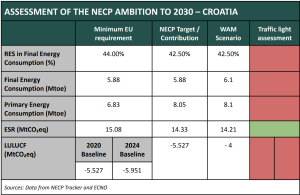
 Assessment of Croatia’s updated National Energy and Climate Plan –
Check the full NECPs assessment here
Ambition gap
Energy – Even by implementing all additional policies and measures (WAMs) presented in the NECP, Croatia would fail to meet the minimum EU requirements for energy efficiency and renewables. The renewable energy sources target and the corresponding WAM set in the NECP are not in line with the expected national contribution. The plan does not sufficiently address barriers to renewables deployment, such as administrative delays, grid limitations, and lack of incentives for small-scale and community-based projects. For what concerns energy efficiency, the national contribution for final energy consumption is in line with the requirements of the Energy Efficiency Directive (EED); however, this is not the case for primary energy consumption. According to the WAMs, Croatia’s policies and measures (PAMs) will not be sufficient to be in line with the minimum EED obligations, therefore more measures are needed. The absence of concrete policies on renovation of the building stock, efficient heating and cooling, and behavioural change programmes for households and SMEs further weakens the credibility of the efficiency component.
Climate – With the WAM scenario presented in the NECP, Croatia would seemingly reach the minimum decarbonisation target for sectors falling under the Effort-Sharing Regulation (ESR) but not for the Land Use, Land-use Change, and Forestry (LULUCF), registering a notable absence of robust monitoring frameworks for many of them. Without clearly assigned indicators, baselines, or timelines for implementation and evaluation, it is difficult to assess progress or ensure accountability. The ESR target and respective WAM scenario presented in the plan are in line with the EU requirements but the measures of specific sectors do not seem to be adequate. In particular, policies and measures (PAMs) proposed for the transport sector, one of the largest and growing sources of emissions in Croatia, are fragmented and fail to provide a coherent decarbonisation strategy.
Concerning the LULUCF sector, the actual measures proposed are neither sufficiently ambitious nor operationalised in a way that guarantees the sink will be maintained or strengthened. This is particularly critical given that the carbon sink in 2024 is already under pressure and has shown signs of weakening.
➢ Improve the renewables target and provide additional PAMs to reach the minimum EU requirement for renewables
➢ Improve the primary energy consumption contribution and provide additional PAMs to align with the minimum EU requirements for primary and final energy consumptions
➢ Provide additional PAMs to ensure climate targets are achieved
Financing gap
The NECP includes an overview of Croatia’s investment gap, as it provides an estimate of total investment needs per sector according to the WAM scenario, as well as an overview of available funds. This is rather positive. However, the plan fails to associate individual policies and measures to investment needs and sources of financing in a systematic way. While sources of funding are clearly defined for some PAMs (for instance, certain energy renovation programs and grid investments), in several other circumstances needs and resources remain under-defined (notably, for PAMs in the transport and agriculture sectors), when not totally absent (for instance, PAMs related to behavioral change and local energy communities). Another significant gap is the limited mobilisation of private capital. The plan notes that private investment will be required, especially in the residential and commercial sectors, but lacks concrete instruments that would catalyse such investments.
Unfortunately, the NECP still foresees public financial resources being directed toward fossil fuels, including the expansion of gas pipelines, the increase of the LNG terminal capacity and the exploration of potential hydrocarbon deposits. Also, it does not provide any comprehensive list nor clear phaseout date for fossil fuel subsidies, despite including a measure that foresees their elimination.
➢ Provide details on investment needs and sources of financing for all PAMs. Include a strategy to mobilise private investments.
➢ Halt the expansion of fossil gas infrastructure and include a clear phaseout date for fossil fuel subsidies.
Just Transition gap
A socio-economic impact assessment was conducted for the policies included in the NECPs but it only focuses on some sectors and does not recognise the gender dimension in the evaluation of social impacts. The assessment contains the analysis of macroeconomic effects calculated by input-output analysis, and estimates that the potential adverse social effects of the transition on the whole economy are not relevant. However, the transition is likely to have macro-economic implications in regions highly dependent on coal and oil plants, for which no targeted support is foreseen. The NECP includes two measures that tackle energy and transport poverty and both are related to the development of programmes to alleviate them; there is no comprehensive approach throughout the document. There is also one measure related to the drafting of the Social Climate Plan (SCP) which mentions ETS2 and its effects on vulnerable groups. Apart from this, energy poverty is only mentioned within measures that tackle energy efficiency and energy renovation of buildings. On green jobs, the plan outlines the measure “ENU-12” to develop a framework to ensure adequate skills in the context of green jobs required for building renovation. However, this is the only measure where this topic is tackled.
➢ Improve the socio-economic impact assessment of PAMs
➢ Provide a national energy poverty target and trajectory to achieve it
➢ Provide additional PAMs to tackle transport poverty and the impacts of the transition on workforce re/upskilling
Public Participation gap
Croatia conducted a public consultation for its updated NECP exclusively through a national online platform, without any in-person meetings or events. The consultation period lasted one month but it took place after the European Commission had already issued its recommendations, meaning that major policy choices were likely already set. The consultation occurred late in 2024, as part of a generally delayed NECP development process. While the Ministry provided some information on the regulatory context and decision-making process, it generally lacked clarity and transparency and the communication relied mainly on the Ministry’s website and NGO channels. It is still uncertain how the public input has been reflected in the final revised NECP. ➢ Improve the timeline of public consultations for them to occur before key decisions are made
➢ Increase and diversify participation formats, including in-person meetings and broader outreach to boost inclusivity and engagement
➢ Improve transparency by clearly explaining the consultation purpose, the decision-making process, and reporting publicly how the public feedback will be used