
 Assessment of Czechia’s updated National Energy and Climate Plan –
Check the full NECPs assessment here
Ambition gap
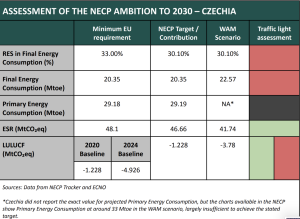
Energy – Even by implementing all additional policies and measures (WAMs) presented in the NECP, Czechia would not meet the minimum EU requirements for both renewables and energy efficiency. Despite the Commission’s and national CSOs’ recommendations calling for a higher renewable energy sources target, it has not been increased beyond the original 30%, with the respective WAM scenario also lagging behind. The national contribution for final energy is mostly in line with the minimum Energy Efficiency Directive (EED) obligation, but it is projected to be missed due to insufficient policies and measures (PAMs) in the WAM scenario. Also the national contribution for primary energy is in line with the minimum EED obligation, however the little information retrievable from the plan on the respective WAM indicates that additional measures would be needed to close the gap towards the national contribution for primary energy.
Climate – With the WAM presented in the NECP, Czechia would seemingly reach a higher reduction than the minimum decarbonisation target for sectors falling under the Effort-Sharing Regulation (ESR), but sufficient PAMs to credibly back that scenario are lacking.
For Land Use, Land-use Change, and Forestry (LULUCF), the plan does not provide detailed modelling. The WAM scenario only claims that, according to current developments, Czechia could reach -3.78 MtCO2eq of carbon sinks by 2030. This figure would be sufficient to align with EU regulation if we based our analysis on the 2020 baseline (used in the LULUCF regulation), but it would not be sufficient if we base our analysis on the updated 2024 dataset.
➢ Provide additional PAMs to achieve the minimum primary and final energy consumption contributions
➢ Align the renewables target with the minimum EU requirement and provide consistent additional PAMs to reach it
➢ Provide additional PAMs to achieve the LULUCF target
Financing gap
The NECP fails to provide an assessment of its financing gap. It includes almost no information on the overall investment needs, and it only presents a summary of already existing funding sources, without integrating them to the plan. The individual policies and measures are also not associated with investment needs or sources of financing. In addition, the plan lacks any commitments and plans to phase out fossil fuel subsidies. On the contrary, the NECP even explicitly says that Czechia has no intention of phasing them out systematically as they are “key to achieving the EU’s objectives on climate protection, reducing air pollution, increasing the share of renewable energy sources and reducing energy intensity”. This is in contradiction with international commitments and the Commission’s recommendations issued for the draft updated NECPs. A basic list of direct subsidies is provided, but it is incomplete and in contradiction with other parts of the plan (claiming that only housing allowances qualify as subsidies).
➢ Include a thorough estimation of investment needs and funding sources to calculate the financing gap
➢ Conduct a thorough mapping of all fossil fuels subsidies and develop a plan for their phaseout.
Just Transition gap
The final NECP includes projected impacts of the WAM and WEM scenarios on energy poverty of different segments of the population and different regions, with clear positive impacts of the WAM scenario on most households. However, the gender dimension is not recognised in the assessment of social impacts.
The plan lists energy efficiency and decarbonisation measures to support vulnerable groups partially through the inclusion of successful existing financial programs of “New Green Savings” and “New Green Savings Light” supporting energy savings for households as the main measures of tackling energy poverty. The Social Climate Fund is only mentioned very briefly and in general terms as a way of targeting vulnerable groups but every mention of ETS2 has been deleted from the NECP as a political decision. The NECP notes that Czechia still does not have a national definition of energy poverty, but it does include relevant data estimating its level and some projections for the WAM scenario. Nevertheless, no specific me
asures nor specific objectives designed to reduce energy and transport poverty are listed. The NECP doesn’t include a comprehensive set of targeted policies to maximize the employment benefits and mitigate potential adverse impacts of the transition.
➢ Integrate the plan with a comprehensive set of policies and measures to address energy and transport poverty
➢ Provide additional PAMS to maximize the employment benefits and mitigate potential adverse impacts of the transition
Public Participation gap
The public consultation carried out during the NECP upda
te featured the establishment of the Platform for Energy and Climate Strategies in April 2023, which included a limited range of stakeholders (notably only two civil society representatives). Members had access to working drafts and could submit comments. However, local and regional authorities were only indirectly involved via their associations, with no direct consultations at those levels. Two rounds of online public consultations were held using a basic online form. The first round (May–June 2023) lasted less than three weeks and began without prior notice, with no draft or supporting materials available. The second round (Jan–Feb 2024) ran for about seven weeks, also without prior notice, and offered only a link to the draft NECP, with no additional explanatory material. The final NECP includes a link to a summary of consultation responses but does not explain how public input influenced the final content. There was no evidence that stakeholder or public feedback significantly shaped the final NECP.
➢ Enhance transparency and communication: clearly explain the regulatory framework and decision-making process to the public and specify how the consultation feedback is reflected in the final plan
➢ Start consultations earlier and improve accessibility: engage stakeholders and the public before key drafts are finalized and provide adequate supporting material during consultations