
 Assessment of France’s updated National Energy and Climate Plan –
Check the full NECPs assessment here
Ambition gap
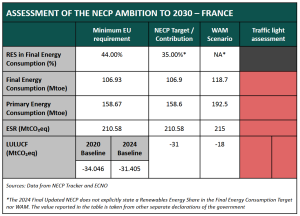
Energy – By implementing all additional policies and measures (WAMs) presented in the NECP, France would fail to meet the minimum EU requirements for renewables and energy efficiency. For each renewable energy source, the French NECP indicates either a capacity objective or a generation objective for wind, solar, hydropower, biogas, biofuels and renewable heat & cold production. A forecast of 570 TWh of renewable energy by 2030 is mentioned, but it is not yet formally approved by French legislation: the “Programmation pluriannuelle de l’énergie” (PPE) was supposed to be published in 2023, but has yet to be finalized. Given this context, the 2024 Final Updated NECP does not explicitly state a renewables target nor the connected WAM scenario. In fact, France is opposed to including a RES target and supports inclusion of a low-carbon energy target.
For what concerns energy efficiency, the national contributions for both primary and final energy consumption are in line with the requirements of the EED. However, the impact of policies and measures (PAMs) modelled until now under the WAM scenarios will not be sufficient to achieve the national contributions for primary and final energy (to be confirmed in the final version of the SNBC and PPE documents).
Climate – With the WAMs presented in the NECP, France would fail to meet the minimum decarbonisation targets for both sectors falling under the Effort-Sharing Regulation (ESR) and for the Land Use, Land-use Change, and Forestry (LULUCF) sector.
France presents an ESR target aligned with EU legislation, which however is not backed up by sufficient measures and consistent projections. The NECP includes carbon budgets for non-ETS sectors, for 2024-2028 and 2029-2033. There are no set targets for 2030 but rather multi-year “budgets” for 2029-2033 which however still need to be approved on the final round of modeling and consultations of the third Stratégie nationale bas-carbone (SNBC), currently underway.
France also explicitly acknowledges that its LULUCF sector will not meet previous carbon sink projections, due to a greater-than-expected decline in absorption capacity. While the LULUCF Regulation requires a target of -31.405 MtCO₂eq by 2030 (-34.046 MtCO2eq with the 2020 Baseline), the provisional targets in the NECP are significantly lower: -18 MtCO₂eq (2029–2033) instead of the previous -47 MtCO₂eq. These lower figures reflect a realistic reassessment of what France can absorb and will be finalized in the upcoming SNBC as well.
→ France should provide a RES target fulfilling at least EU requirements and develop more measures to reach it, particularly for onshore wind power
→ France should provide additional measures to meet the EU benchmarks for energy efficiency
→ France should provide additional PAMs to meet its ESR and LULUCF target
Financing gap
The plan does not provide a fully comprehensive assessment of its financing gap. It reports on the overall investment needs for the green transition through a report commissioned by the Prime Minister published in 2023 which, however, does not build on PAMs outlined in the NECP. The report estimates that the French ecological transition requires an additional net EUR 66 billion/year and a cut in brown/carbon-intensive investments by EUR 35 billion/year. In some cases, the NECP specifies the source of financing for PAMs, or financial instrument and scheme the policies rely on (for renovation, energy efficiency or industrial decarbonization for instance), but not systematically. Also, the national budget is currently not consistent with the financing required to implement the policies and measures listed in the NECP. In 2024, climate and environmental policies suffered major budget cuts.
The mentioned cuts should start from the phase out of fossil fuel subsidies, which the NECP fails to list comprehensively. A comprehensive timeline to phase them out is also missing: the NECP mentions some recent evolutions lowering fiscal advantages for fossil fuels, but does not list the other fossil fuel subsidies that need to be gradually phased out.
→ Provide a comprehensive assessment of the financing gap, by improving the integration of investment needs and sources of financing with PAMs
→ Map and phase out all fossil fuels subsidies
Just Transition gap
The NECP does not systematically assess the socio-economic impacts of the policies and the gender dimension is not addressed at all in this regard. The plan is very explicit on the particular transition challenges faced by French regions and territories with coal stakes and what is in place to support the transition. However, the NECP does not cover other particular transition challenges such as the automobile and high emitting industry sectors and the data are very general, lacking substantial content. On the other hand it does list supporting and/or corrective measures to minimize the impact on low income households.
France sets a national objective to reduce the energy poverty indicator based on the (weather-adjusted) energy effort rate of 0.5% by 2030 compared to 2022: this indicator is crucial but the rate is too slow.
In addition, there are several measures designed to reduce energy poverty (MaPrimeRenov to support renovation costs by low income households, the energy check to help pay for rising energy costs) and transport poverty (leasing scheme for electric vehicles for low income households).
Despite the legal requirements adopted in the 2015 Climate Law, France still does not have a Multi Year Plan for Skills and Jobs in the energy transition. The plan lists the sectors in need of actions for re/upskilling (based on the data by the SGPE (Secretariat General for Ecological Planning) and assesses the positive and adverse effects on the job market.
→ Improve socio-economic impact assessment, including the gender dimension
→ Address the transition challenges in missing sectors e.g. automobile and high emitting industry
Public Participation gap
France didn’t carry out a direct public consultation on the updated NECP as a whole. Instead, three separate consultations have been organised focused on related strategies: the Stratégie nationale bas-carbone (SNBC) and the Programmation Pluriannuelle de l’Énergie (PPE). These were online and relatively long in duration (3.5 months, 1 month, and 6 weeks respectively), but none directly targeted the NECP, and only the first occurred early enough to potentially influence content.
The consultations led to few meaningful changes, and the last consultation occurred after the NECP’s submission, limiting any real opportunity for stakeholder influence, whose extent remains unclear.
→ Target the consultation process specifically on the NECP
→ Clarify how the stakeholders feedback has been incorporated into the final plan