
 Assessment of Italy’s updated National Energy and Climate Plan –
Check the full NECPs assessment here
Ambition gap
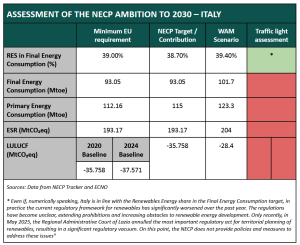
Energy – By implementing all additional policies and measures (WAMs) presented in the NECP, Italy would meet the minimum EU requirements for renewables, but it would fail to meet the minimum EU requirements for energy efficiency. Italy has improved its estimated trajectories for the national renewables target, but it should have included detailed and quantified policies to back it up in a timely and cost-effective way, which is not the case. For energy efficiency, Italy is in line with the minimum Energy Efficiency Directive (EED) obligation for its final energy contribution, but not for its primary energy contribution. It shall be noted that the primary energy contribution is coherent with the EED deviation of the EED formula to calculate national contributions. WAM projections nonetheless indicate that, without additional measures, Italy would fail to achieve its commitments for both final and primary energy consumption. Current policies, such as Ecobonus, Conto Termico, and Certificati Bianchi, excluding the Superbonus, are projected to achieve a lower energy consumption reduction than the set objective. At the same time, given past trends in renovation efforts, it remains unclear how the supposedly higher ambition proposed in the plan will be implemented.
Climate – With the WAM scenario presented in the NECP, Italy would not reach its minimum decarbonisation targets. The target presented in the NECP for sectors under the Effort-Sharing Regulation (ESR) is in line with the minimum EU requirements, but all available information demonstrates that the (poorly described) policies and measures (PAMs) outlined in the plan are insufficient to meet the country’s obligations. Similarly, the modest Land Use, Land-use Change, and Forestry (LULUCF) target set in the NECP is aligned with the minimum EU requirement only on paper. According to the WAM scenario, the proposed PAMs are insufficient to achieve it.
→ Align the national contribution for primary energy with the EED and provide additional PAMs to align with minimum EU requirements for both final and primary energy consumption
→ Provide more PAMs to back up the minimum national contribution for LULUCF and ESR objectives
→ Align policies and measures with targets included in the plan: provide a systematic correlation between the described policies and their effectiveness in reducing sectoral emissions based on verifiable data
Financing gap
The Italian NECP provides only a partially sufficient assessment of its financing gap. The plan does provide an estimate of investment needs, specifically for the evolution of the energy system (EUR 174 billion of additional investments compared to the WEM scenario in the 2024-2030 period). However, the proposed policies and measures are not linked to clear funding needs and sources in a systematic way, except at an overall sectoral level.
On the other hand, public resources are still employed to reinforce the role of gas and gas infrastructure (LNG terminals and pipelines) through 2030, with significant investments and initiatives aimed at positioning Italy as a regional gas supply hub. Also, while the NECP formally reiterates the commitment to phasing out fossil fuel subsidies, it fails to provide a clear, concrete exit strategy, despite multiple specific recommendations received from the Commission (on the draft updated NECP).
→ Provide clear funding needs and sources for all PAMs
→ Halt the expansion of fossil gas infrastructure and develop a phaseout strategy for fossil fuel subsidies
Just Transition gap
The Italian NECP does not systematically assess the positive and adverse socio-economic impacts of the planned policies and measures, nor does it include a comprehensive set of targeted policies to maximize social benefits and mitigate potential adverse impacts of the transition.
The plan does not establish national objectives for energy poverty. It provides only vague references to existing measures such as social bonuses, which, while helpful, are passive and insufficient to tackle its root causes. The measures designed to reduce energy poverty are not linked to future Social Climate Plans and there are no measures aimed at addressing transport poverty or the social disparities it exacerbates.
The NECP considers employment impacts only in an aggregated manner and a significantly greater investment in the training sector appears indispensable. Currently, this area is insufficiently addressed in the plan, providing poor clarity on how to balance potential job losses resulting from the transition.
→ Provide additional PAMs and a national objective to address energy poverty
→ Provide additional PAMs to address transport poverty
→ Provide PAMs for the creation of new professional qualifications and re/upskilling pathway for workers involved in the fossil energy sector
Public Participation gap
The public participation process mainly took place through two online consultations. The first, held in May 2023, was based on multiple-choice questions without providing public access to the draft NECP. A second open-ended questionnaire was available online in February–March 2024, but again without sharing the actual NECP text or fostering real dialogue. Three closed-door thematic tables were also held with institutional stakeholders (ministries, agencies, trade unions, industry associations) but NGOs were excluded. Public communication was poor, with minimal promotion of the consultations and limited information on the NECP’s content, regulatory context or decision-making process. The timing of the first consultation, only about a month before the draft NECP was submitted, left little opportunity to meaningfully incorporate public input. No real evidence was provided on how consultation feedback was taken into account.
→ Improve consultation quality: provide adequate information and time to enable meaningful stakeholders participation, including NGOs
→ Clarify how the stakeholders feedback is incorporated into the final NECP