
 Assessment of Portugal’s updated National Energy and Climate Plan –
Check the full NECPs assessment here
Ambition gap
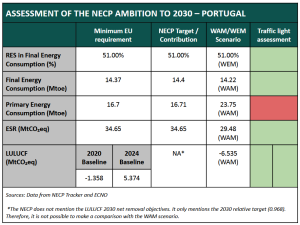
Energy – By implementing all additional policies and measures (WAMs) presented in the NECP, Portugal would meet the minimum EU requirements for renewables, but it would partly fail to meet the minimum EU requirements for energy efficiency. The existing measures (WEM) scenario seems to back up the renewables target, nevertheless outlined measures are generally vague and with uncertain effects.
While Portugal’s national contributions for both final and primary energy consumption for 2030 are aligned with the minimum Energy Efficiency Directive (EED) obligations, the WAM scenario shows an increase in primary energy consumption instead of the needed decrease compared to 2023. The plan attributes the expected rise in primary energy according to projections to the electrification and the energy demands of the green industry, mainly linked to hydrogen production for export via the H2MED project. The missing alignment of projections with additional measures compared to the national contribution for primary energy however indicates that more measures need to be planned.
Climate – With the WAM scenario presented in the NECP, Portugal would seemingly reach the minimum decarbonisation target for sectors falling under the Effort-Sharing Regulation (ESR). However, while the scenarios foresee a sharp decrease in emissions in the energy and industry sector, planned policies and measures (PAMs) seem in practice insufficient to reach specific sectoral targets for the transport and agriculture sectors. The plan includes a 2030 reduction target of 40% in transport and 11% in agriculture (compared to 2005 levels), while the corresponding WAM scenarios for the specific sectors achieve only 30% and 6%, respectively. The transport sector is particularly worrysome due to its weight in national emissions (34.3% in 2023) and the current upward trend in emissions.
On the other hand, the WAM scenario presented for the Land Use, Land-use Change, and Forestry (LULUCF) sector seems to be sufficient to align Portugal with the minimum EU requirements for 2030 (the target itself could not be assessed as it is expressed only in relative terms (-0.968)).
→ Align the primary energy contribution with minimum EED obligations and provide additional PAMs to achieve it
→ Provide additional PAMs for transport and agriculture to ensure that the minimum EU requirement for the Effort-Sharing sector is achieved; prioritise the electrification of all duty vehicles and heavy passenger vehicles, combine energy storage in batteries with logistics and public transport platforms
Financing gap
The NECP fails to provide all information needed for a comprehensive assessment of its financing gap. The plan does not provide an estimation of overall investment needs required to implement the planned PAMs. It provides an overview of potentially available sources of financing, but it does not clearly associate them with specific policies and measures presented in the plan. Individual policies and measures often feature funding sources, but the amount is never mentioned.
On the other hand, the plan does not make significant progress in diverting resources away from fossil fuels subsidies. Subsidies are discussed in a few sections of the plan, including one measure addressing the phaseout of coal-generated electricity before 2030. However, the plan only provides an incomplete list of fossil fuels subsidies, and has no clear exit strategy or date for their phaseout.
→ Provide detailed information on investment needs of PAMs
→ Provide a clear timeline to phase out fossil fuel subsidies and redirect funds to the green transition
Just Transition gap
The NECP does not systematically assess the positive and adverse socio-economic impacts of individual policies and measures. A general socio-economic impact assessment exists for the overall WAM scenario but lacks detailed analysis per measure. Impacts on vulnerable households and specific territories are acknowledged but not thoroughly assessed, with some references to Just Transition initiatives. There is no integration of the gender dimension, and the NECP postpones a comprehensive social risk analysis to a future Just Transition Strategy, planned over a 2020–2030 timeframe, which is inadequate to address immediate impacts.
The plan includes some measures to reduce energy poverty, notably through the Long-Term Strategy to Combat Energy Poverty (ELPPE) and the creation of the National Energy Poverty Observatory (ONPE-PT). However, inconsistencies and unclear progress on implementing the related Action Plan (PACPE 2024–2030) weaken credibility. Existing measures on energy poverty often remain too generic and are not always adapted to the realities of vulnerable groups, needing stronger funding, technical support and communication. While objectives and timeframes for reducing energy poverty are clearly listed, transport poverty is not addressed systematically — and measures like public transport incentives are not specifically targeted at low-income citizens.
The NECP mentions the sectors where re/upskilling should focus but does not offer a comprehensive, immediate set of policies to protect workers displaced by the transition. It refers broadly to the Just Transition Fund and past retraining efforts but lacks structured, forward-looking plans for income maintenance or proactive re/upskilling. The planned Just Transition Strategy is key but lacks specific dates for delivery, making it insufficiently urgent.
→ Conduct detailed socio-economic assessments for all key measures addressing gaps such as gender and territorial analysis
→ Enhance PAMs to combat energy and transport poverty
→ Develop structured re/upskilling and income protection programs
Public Participation gap
Two online public consultations were conducted. The first, held early in the update process, gathered feedback via a questionnaire based on the 2019 NECP version, rather than a draft updated version. The second consultation allowed free-format document submissions and took place shortly before the final updated NECP submission deadline. In addition, five in-person participatory assemblies were organized across the country early in the process, involving public authorities and civil society. The first consultation happened early eough but was not based on a relevant draft, while the second came too late for meaningful changes. Information on WEM and WAM scenarios was shared only in the second round. Although some regulatory context was provided, details on the decision-making process were missing, especially at the start of the update.
→ Improve consultation quality: share adequate information on the plan with stakeholders on content and on the procedure to allow for a meaningful consultation
→ Clarify how the stakeholders feedback has been incorporated in the final NECP