
 Assessment of Slovenia’s updated National Energy and Climate Plan –
Check the full NECPs assessment here
Ambition gap
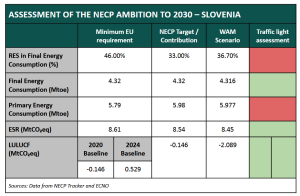
Energy – By implementing all additional policies and measures (WAMs) presented in the NECP, Slovenia would not meet the minimum EU requirements for renewables, and it would partly fail to meet the minimum EU requirements for energy efficiency. The renewables target is set to 33% by 2030, which is 13 percentage points below the minimum EU benchmark, and is not even backed up by the corresponding WAM scenario.
For what concerns energy efficiency, Slovenia’s national contribution is in line with the minimum Energy Efficiency Directive (EED) obligation for final energy consumption, however this is not the case for primary energy consumption, whose WAM scenario confirms that additional measures are needed to fulfil the EED obligations. Additionally, the reduction of final energy consumption is planned in all sectors except for industry, which causes a majority of the burden to fall on the wide-use sector, including households. This is not in line with the just transition principle, which the Slovenian NECP mentions as one of its key objectives.
Climate – With both WAM scenarios presented in the NECP (which also include sectoral projections), Slovenia would reach the minimum decarbonisation target for sectors falling under the Effort-Sharing Regulation (ESR). Nonetheless, significant additional potential remains in the transport and agriculture sectors, as emissions are projected to decline by only 1% in the transport sector and by only 2.8% in the agriculture sector (compared to 2005 levels).
Similarly, the Land Use, Land-use Change, and Forestry (LULUCF) target set in the NECP is aligned with minimum EU requirements for 2030, and so do the projections of its WAM scenario.
→ Align the renewables target with EU benchmarks and provide additional policies and measures (PAMs) to achieve it, including a detailed financial assessment and feasibility analysis compared to the nuclear scenario. Measures to support energy communities should be improved, given the increasing interest of municipalities and citizens to participate in community self-supply projects
→ Align the primary energy contribution with EU benchmarks and provide additional PAMs to achieve it
→ Include additional measures for the industry sector and introduce stricter criteria to allocate financial incentives for industry
Financing gap
Slovenia provides a clear assessment of the investment needs required to implement the WAM scenario (EUR 57 billion for the 2021-2030 period, which would still be insufficient to align with the Paris Agreement goals, due to the poor ambition of the plan). The NECP also provides the figures to estimate a public investments gap (around EUR 1 billion for the 2024-2030 period), but it fails to detail how private investments will be mobilised. Also, investment needs and the allocation of funding sources are not identified for the individual policies and measures.
At the same time, the final NECP weakens previous commitments to phase out fossil fuel subsidies, with significant backtracking after public consultations due to industry pressure. While it mentions the intention to phase them out, the latest version of the NECP removed or watered down key provisions related to ending fossil fuel subsidies, particularly around transport and industry. This weakens the credibility of Slovenia’s commitment to a fossil-free future and still locks essential funding sources into incompatible assets with the green transition.
→ Allocate investment needs and funding sources to individual policies and measures
→ Do not weaken previous commitments to phase out fossil fuel subsidies
Just Transition gap
The NECP provides only a partial assessment of the socio-economic impacts of policies and measures, without a comprehensive vision. Although it recognizes the need for a just transition, particularly in coal and carbon-intensive regions, it lacks a clear and cohesive set of targeted policies to maximize social benefits or mitigate adverse effects. The gender dimension and broader impacts on vulnerable groups are insufficiently addressed. The final plan sets national targets to reduce energy poverty (to 3.8–4.6% by 2030) and achieve 8000 energy efficiency and renewable energy investments in energy-poor households. It also sets a cumulative energy savings target of 573 GWh for vulnerable households by 2030. Measures to tackle energy and transport poverty are included, notably through the Energy Poverty Action Plan (2023–2026), but they remain fragmented and not fully integrated into a broader social strategy. In fact measures to address transport poverty are mentioned but detailed actions are postponed to the forthcoming Social Climate Plan. On employment impacts, the NECP mentions re/upskilling needs but does not specify target sectors or offer adequate measures to address skills shortages for the clean energy transition.
→ Improve the socio-economic assessment of PAMs, including impacts on vulnerable groups including the gender perspective
→ Provide more detailed PAMs on re/upskilling initiatives comprehensive socio-economic strategy integrating all social impact measures, including clear links to funding sources like the Just Transition Fund
Public Participation gap
The NECP revision was technically well prepared. A preliminary online consultation took place in 2022, followed by two online consultations on the draft NECP in 2023 and one formal consultation on the final document in 2024. Workshops were also held as part of the Strategic Environmental Assessment (SEA) process, alongside meetings with selected stakeholders.
The preliminary consultation lasted 8 weeks; the others lasted one month each. The consultation process started early enough for public input to meaningfully influence the plan. However, information about new measures (WAM) was delayed and only made available in December 2023. On another note, the regulatory context and decision-making procedure were well explained, with a dedicated webpage centralising all information for the public. Despite a technically well-executed participatory process, many calls for strengthening the targets were ignored and short-term industry interests prevailed.
→ Ensure full information, including on WAM scenarios and/or new measures, is shared from the beginning