
 Assessment of Spain’s updated National Energy and Climate Plan – gaps and opportunities
Check the full NECPs assessment here
Ambition gap
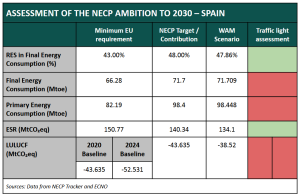
Energy – By implementing all additional policies and measures (WAMs) presented in the NECP, Spain would meet the minimum EU requirements for renewables, but it would fail to meet the minimum EU requirements for energy efficiency. On renewables, Spain is projected to be beyond the minimum EU requirements, but effective implementation must consider that only 35% of the economy is expected to be electrified by 2030, despite rising electricity demand. On the other hand, Spain’s national contributions for both primary and final energy consumption and the WAM scenario by 2030 is not in line with the minimum Energy Efficiency Directive (EED) obligation. More measures need to be planned to align with the EED.
Climate – According to the WAM scenario presented in the NECP, Spain would reach the minimum decarbonisation target for sectors falling under the Effort-Sharing Regulation (ESR). Nonetheless, significant additional potential remains in all ESR sectors. On the other hand, the Land Use, Land-use Change, and Forestry (LULUCF) target set in the NECP is aligned with the minimum EU requirement only on paper. According to the WAM scenario, the proposed policies and measures (PAMs) are insufficient to achieve it.
→ Provide additional PAMs to align with minimum EU requirements for primary and final energy contributions. Include measures to reduce energy consumption across all sectors, including buildings’ renovation, effective mobility plans and railway traffic of goods
→ Provide additional PAMs to meet the LULUCF target by acting upon carbon sinks, nature restoration and the agriculture sector and reducing nitrous oxide emissions from fertiliser use and methane from livestock
Financing gap
The NECP includes an estimation of the overall investment needs to achieve the objectives of the plan (EUR 308 billion between 2021-2030), with an overview per sector and per contributor (82% of the total is expected to come from the private sector, while EU funds are expected to cover most of the remaining 18% public sector investments). Unfortunately, it does not provide an equally thorough overview of available sources of financing, therefore preventing the assessment of the existing financing gap. In addition, not all individual policies and measures include a clear and robust explanation of their financing needs and sources. Those related to energy efficiency, energy security and the internal market tend to have more detailed explanations than decarbonisation measures.
On the other hand, the NECP does not make significant progress in diverting money away from fossil fuels. The plan does not foresee a gas phaseout date, and actually includes several measures that perpetuate the use of fossil gas, either directly or indirectly. In addition, while it presents a list of fossil fuel subsidies, it does not include a clear exit date or a plan for their phaseout.
→ Address the financing gap by assessing the available sources of financing, which have to be linked systematically to all individual policies and measures
→ Establish a clear timeline for the phase out of fossil gas and the end of fossil fuels subsidies to achieve a 100% renewable electricity sector in 2030
Just Transition gap
The final NECP does not systematically assess the positive and adverse socio-economic impacts of all planned policies and measures. However, it incorporates specific measures that provide greater support to vulnerable consumers and measures that generate positive socio-economic impacts in rural territories. The Spanish NECP includes a very positive new measure in the additional dimension on transversal aspects of the ecological transition dedicated exclusively to the gender perspective. Which makes, however, that the gender dimension is not well reflected in each planned policy and measure.
The plan does not include a national objective nor a timeframe to tackle energy poverty but includes a measure focusing on this issue. It features a set of 4 indicators of energy poverty for 2019 and, based on these indicators, the NECP concludes that 12.35% of the total final accumulated energy savings objective should come from actions aimed at mitigating energy poverty or aimed at vulnerable groups. Measures to tackle energy poverty include strengthening the electricity social bonus and plans to update the national Energy Poverty Strategy (2024–2029).
Regarding transport poverty, the updated plan mentions the “Strategy on Sustainable Mobility 2030” and points out the integration of the specific needs of rural, remote, low-density, island areas, etc., plus issues related to gender and poverty in transport and mobility with support for vulnerable users.
The NECP outlines several measures targeting employment benefits and mitigating adverse impacts and it emphasizes the workers re/upskilling, especially in vulnerable groups, although specific sectors are only partially identified. The plan forecasts 560,000 net new jobs by 2030 and major economic benefits, including a EUR 44 billion annual GDP increase and substantial public health improvements.
→ Provide a clear energy poverty objective and respective timeline
→ Improve the socio-economic impact assessment of PAMs
Public Participation gap
The revision of the NECP combined both online and in-person consultations. A preliminary online consultation was held in summer 2022 without a draft NECP. In spring 2023, three (upon invitation-only) in-person sessions discussed pre-set questions without draft texts. A second public consultation on the draft NECP followed online in summer 2023. In spring 2024, further sessions on renewable deployment were held, with livestreams and online contributions. Finally, a third online consultation on the Strategic Environmental Study took place in summer 2024, based on the updated draft NECP. The consultation process started early enough to be meaningful, with the first round launched in summer 2022. However, it remains unclear how the input received, over 2,000 contributions in the first phase and over 10,000 in the second, was actually incorporated in the final NECP. During the first phase, the public only had access to information about WEM scenarios, while WAM scenarios were only shared later with the draft NECP.
→ Clarify how the stakeholders feedback has been incorporated into the final plan
→ Improve participation process: provide comprehensive and timely information to stakeholders