
 Assessment of Bulgaria’s updated National Energy and Climate Plan –
Check the full NECPs assessment here
Ambition gap
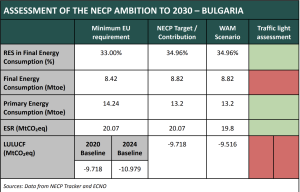
Energy – According to the additional measures scenarios (WAM) presented in the NECP, Bulgaria would seemingly meet the minimum EU requirements for renewables, but it would partly fail to meet the minimum EU requirements for energy efficiency. On renewables, both the NECP target and the WAM scenario are slightly above the minimum EU requirement. For primary energy consumption, Bulgaria is more ambitious than the minimum Energy Efficiency Directive (EED) obligation, while both the national contribution and the WAM scenario for final energy consumption are not aligned with the EED. However, the plan does not include credible and systemic information on the policies and measures that would be required to implement such scenarios, notably for energy efficiency. The plan also fails to include a target nor measures for reducing methane emissions in the energy sector.
Climate – With the WAM presented in the NECP, Bulgaria would be seemingly on track to reach the minimum decarbonisation target for sectors falling under the Effort-Sharing Regulation (ESR). However, unclear and incomplete policies and measures (PAMs) risk jeopardising the effective emissions reduction. The most glaring gaps are observed for non-CO2 emissions – including methane and N2O from energy, waste and agriculture sectors – and in the transport sector. On sustainable mobility, for instance, the final NECP only includes the same measures undertaken for the past 15 years. These measures, which are mainly dependent on EU funds programs, have failed to bring about substantial change to the sector, not even through the massive targeted investments in urban public transport. On the other hand, the Land Use, Land-use Change, and Forestry (LULUCF) target set in the NECP is aligned with the minimum EU requirement only on paper. According to the WAM scenario, the proposed PAMs are insufficient to achieve it. This might be related to the overestimation of carbon sinks, but it’s hard to say as the respective measures are vaguely described.
➢ Provide additional PAMs to achieve the final energy consumption contribution by 2030 such as: the introduction of the virtual net metering, address the burdensome access to the grid by prosumers, incentivise energy communities for heating and cooling
➢ Provide additional PAMs for the transport sector such as: a clear goal for the reduction of international transit freight traffic and a clear program for the replacement of the long-distance intercity
➢ Provide additional PAMs targeting methane reduction, especially in the waste and oil&gas sectors, in order to ensure the ESR target is truly met
➢ Provide additional PAMs to achieve the LULUCF target by 2030
Financing gap
The NECP fails to correctly assess its financing gap. Investment needs for additional policies and measures – i.e. to implement WAM scenario – are not calculated in a systematic and coherent way; the estimates are provided only for some sectors (such as electricity and heat from renewables). At the same time, funding sources remain extremely vague and are only rarely clearly associated with planned policies and measures.
At the same time, the NECP does not make significant steps forwards when it comes to diverting money away from fossil fuels. Bulgaria claims to provide no fossil fuel subsidies, and therefore its NECP presents neither a list nor a phaseout plan. In reality, the plan foresees a significant expansion of fossil fuel infrastructure, including the expansion of oil and gas infrastructure in the Black Sea and the application of state guarantees for the Vertical Gas Corridor (expanding gas connections with Greece and Romania). It also does not foresee a phaseout of the Balkan-Turkstream, Russia’s last pipeline to Europe. Finally, the plan risks channeling financial resources towards costly and/or unproven technologies such as nuclear (two unnecessary new nuclear reactors are planned) and CCS technologies (Bulgaria likely aims to become the regional hub for CO₂ storage).
➢ Complete the assessment of investment needs for all sectors, and associate planned policies and measures to clear sources of financing
➢ Halt the expansion of fossil gas infrastructure; rather plan for its phase-out
➢ Specify how and when the existing fossil fuels subsidies will be phased out
Just Transition gap
The NECP does not systematically assess the positive and adverse socio-economic impacts of planned policies and measures, particularly on vulnerable households and regions facing specific transition challenges, such as coal-dependent areas. The gender dimension is not tackled at all. In addition, the plan doesn’t include a comprehensive set of targeted policies to maximize the employment benefits and mitigate potential adverse effects of the transition. It also fails to clearly identify the sectors that require focused re/upskilling efforts. While the NECP refers to the Just Transition Territorial Plans (JTTPs) and related existing programs, these are patchy and lack a strategic approach. The plan acknowledges the introduction of ETS2, the expected increase in prices and its social impact in terms of energy and transport poverty, nevertheless it rather postpones concrete measures to future planning. Despite the high levels of energy poverty in Bulgaria, the NECP provides only a vague and initial assessment of the energy-poor population. It does not include any data on transport poverty, nor a national target and timeline to tackle it.
➢ Conduct a systemic socio-economic assessment of PAMs
➢ Provide targeted PAMs to tackle energy and transport poverty
➢ Plan and implement adequate PAMs to tackle the impacts of the transition on workforce re/upskilling and on vulnerable groups through the Social Climate Plan, Building Renovation Plan and the JTTPs
Public Participation gap
The overall public consultation process fell short to provide a quality public engagement due to the limited format, its short duration and the lack of available modeling and analytical data. The belated first consultation period held in December 2023 lasted just 10 working days, which civil society and the European Commission criticized as insufficient; it was conducted only online with no interactive in-person engagement. The second consultation occurred in late June 2024, very close to the submission deadline, which was still missed. An in-person event was organized, but it served only to present the updated NECP rather than collect public input. The final NECP does not contain a section on how the responses of the public consultation were taken into account, only a vague and non-exhaustive summary of statements. As of today, the Strategic Environmental Assessment is still missing, when it originally had to inform the public consultation process and had to be published together with the draft NECP.
➢ Extend the consultation period and provide both accessible information and adequate time for feedback to allow for a meaningful participation
➢ Publish a summary report clarifying how the public input influenced the final NECP