
 Assessment of Germany’s updated National Energy and Climate Plan –
Check the full NECPs assessment here
Ambition gap
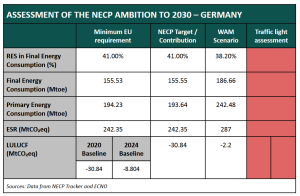
Energy – By implementing all additional policies and measures (WAMs) presented in the NECP, Germany would fail to meet the minimum EU requirements for renewables and energy efficiency. The renewables target meets EU requirements but is not backed by consistent policies and measures (PAMs), and the plan lacks a clear financing strategy to support their implementation. Similarly, the national contributions for both primary and final energy consumption are in line with the requirements of the Energy Efficiency Directive (EED), but, according to the WAM scenario, the measures foreseen in the NECP will not be sufficient to achieve them. Major gaps on energy efficiency PAMs are observed in the transport and heating and cooling sectors.
Climate – With the WAM presented in the NECP, Germany would not reach the minimum decarbonisation target for sectors falling under the Effort-Sharing Regulation (ESR) as well as for the Land Use, Land-use Change, and Forestry (LULUCF) sector.
Germany is expected to miss its national ESR target by 111 MtCO2eq cumulatively (2021-2030 period), according to the NECP. Also, the additional measures included in the plan are not detailed enough, presenting substantial gaps in the transport and building sectors. The Federal Environment Agency estimates that the cumulative ESR target gap would reach 226 MtCO2eq by 2030 under the WAM scenario, which is far higher and contradicts substantially the data included in the NECP.
Similarly, the Land Use, Land-use Change, and Forestry (LULUCF) target set in the NECP is aligned with the minimum EU requirement, but the proposed PAMs are insufficient to achieve it according to the WAM scenario.The German NECP states that the federal 2030 LULUCF target cannot be easily compared with the EU LULUCF target, as they differ in terms of their calculation method and data basis.The new projections show that Germany is neither in line to meet the EU nor its own federal target.
→ Provide additional PAMs to meet the renewables target
→ Provide additional PAMs to align at least with the EED requirements, especially addressing gaps in transport and heating and cooling sectors
→ Provide additional PAMs to meet the ESR target, especially to address gaps in transport and building sectors
→ Provide additional PAMs to meet the LULUCF target
Financing gap
The NECP fails to provide all information needed for a fully comprehensive assessment of its financing gap. On the one hand, it includes a cross-sectoral estimation of overall investment needs to implement WAM scenarios (EUR 690 billion between 2023-2030). On the other hand, it only addresses the issue of financing vaguely, without a sectoral needs analysis or detailed information on how the measures are to be financed. The Federal Government states that it does not plan to address this knowledge gap and the 2024 budgetary cuts to the Federal Climate and Transformation Fund, which jeopardise the financing and thus the implementation of planned measures.
Furthermore, the vast majority of fossil fuel subsidies listed in the plan are not paired with a phase-out date (only one fossil fuel subsidy is associated with a phase out timeline), meaning crucial financial sources are still locked into technologies not compatible with the green transition.
→ Include a thorough and more coherent assessment of sources of financing, clearly linking them with PAMs
→ Provide a detailed and concrete timeline to phase out fossil fuels subsidies
Just Transition gap
The plan includes the socio-economic assessment of impacts of planned policies and measures but a thorough analysis of the effects of the measures is missing. Rural areas and structurally weak regions are explicitly mentioned while the gender dimension is not considered in the assessment of social impacts. The reform of the joint task ‘Improvement of regional economic structure’ (GRW) is a positive step towards modernising the funding conditions and requirements to support transitioning regions. The NECP doesn’t include a comprehensive set of targeted policies to maximize the social benefits and mitigate potential adverse impacts of the transition. Although the plan places a considerable emphasis on ETS 2 to fill the foreseen ESR target gap and acknowledges the risk for vulnerable households to be more severely impacted, it only mentions the Social Climate Fund as a way to directly address these risks.
The NECP doesn’t include national objectives with regard to energy poverty, nor a timeframe for when the objectives are to be met. The plan includes a very limited amount of measures to address energy poverty, such as revenue-based subvention programs for home renovations and revenue supporting measures (Wohngeld-Plus), but fails to offer a systemic concept to address energy poverty, which is not even estimated in the NECP. Transport poverty and associated mitigation measures are not addressed. The “Deutschland Ticket” which decreases the cost of public transport can be regarded as a measure that can mitigate transport poverty, but it is a universal measure benefiting all citizens regardless of their income.
The NECP addresses the issue of the lack of skilled workers overall and it refers to the new Skilled workers strategy and to the Law and Ordinance addressing the further development of skilled labour immigration. However, these relate to the general shortage of skilled workers while no specific measures to overcome their shortage in strategic sectors are identified. The national ‘Roadmap Energy Efficiency 2045’ addressed the issue, but the points elaborated in this working group are not listed in the NECP.
→ Improve the socio-economic impact assessment of PAMs by adopting a systemic approach
→ Provide a national objective and timeline to tackle energy and transport poverty
Public Participation gap
A public consultation on the draft updated NECP did take place, but it was limited in format: participants could only respond via a “satisfaction form” with tick-box questions covering the five Energy Union dimensions, and very limited space for open feedback. While the form was available for 7 weeks (Jan–Mar 2024), this did not allow for meaningful engagement, as it occurred after the draft had already been submitted to the European Commission. Given the timing and restricted format, it’s unlikely that feedback was meaningfully incorporated into the final NECP. Furthermore, no detailed scenarios (WAM) were provided, and the regulatory context and process were poorly communicated, with limited outreach by the Ministry.
→ Improve the quality of consultations: from the design of consultation format to gather substantial feedback to the access to the necessary information (WAM scenarios) in due time to provide meaningful feedback
→ Clarify how and to what extent the stakeholders feedback is incorporated in the final plan