
 Assessment of Hungary’s updated National Energy and Climate Plan –
Check the full NECPs assessment here
Ambition gap
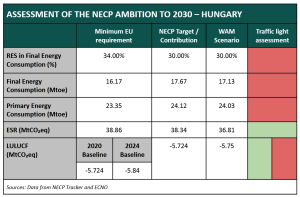
Energy – Even by implementing all additional policies and measures (WAMs) presented in the NECP, Hungary would fail to meet the minimum EU requirements for both renewables and energy efficiency. The renewables target lags behind the minimum EU requirements and is not supported by sufficient policies and measures (PAMs). Notably, the plan fails to tackle the uncertain regulation of renewable energy sources (wind power plants) and energy communities, which are hampering investments.
The plan’s national contributions for primary and final energy consumption are not in line with the minimum obligations as per Energy Efficiency Directive (EED) and, while the additional policies scenarios (WAMs) are slightly more ambitious than the insufficient national contributions outlined in the plan, more measures are needed to align with legal obligations. In Hungary the building stock is responsible for 40% of primary energy consumption, and 16% of total energy consumption could be saved by renovating residential and public buildings. The vast majority of domestic real estates in Hungary (3.85 million households) are considered outdated from an energy perspective and are in need of energy modernization, but the plan fails to outline measures to tackle this issue, thereby undermining investment predictability and attractiveness.
Climate – According to the WAM scenarios presented in the NECP, Hungary would seemingly reach the minimum decarbonisation target for sectors falling under the Effort-Sharing Regulation (ESR).
The Land Use, Land-use Change, and Forestry (LULUCF) target is aligned with minimum EU requirements when taking into account the 2020 dataset baseline, but the corresponding WAM scenario is not backing up the most updated requirements outlined in the 2024 dataset baseline. In addition, the WAM scenario itself is not credible, as it is based on the unrealistic assumption that the forests’ growth will continue at the pace of the recent past.
→ Align the national contribution for renewables with the minimum EU requirements and provide consistent additional PAMs to reach it
→ Align both primary and final energy consumption objectives with EU benchmarks and provide consistent additional PAMs to reach them
→ Develop PAMs to renovate residential and public buildings
→ Set a more realistic trajectory to achieve the LULUCF target
Financing gap
The NECP fails to provide all information needed for a comprehensive assessment of its financing gap. The plan presents an estimate of additional investment needs to implement the additional PAMs compared to the “with existing measures” (WEM) scenario (the yearly net is HUF 177 billion, or EUR 288 million until 2050). However, it does not provide any figures for available sources of financing. The individual policies and measures themselves are also not associated with clear funding needs and funding sources in a systematic way: investment needs and funding sources are specified in some cases, not even mentioned in others. For example, the NECP does not specify whether public resources will be used to build the three planned CCGT gas power plants.
The risk is that essential financial streams will yet again be locked into fossil gas assets, which Hungary is expanding rather than phasing out. The NECP also fails to present a list of fossil fuel subsidies, let alone a plan to phase them out – despite public resources being directed there. One relevant national example is the controversial price cap for households’ gas and electricity consumption (”rezsitámogatás”), which is very expensive and a de facto fossil fuel subsidy not addressing the root cause of energy poverty.
→ Provide a full and coherent list of available public and private financing resources, associated with PAMs
→ Provide a roadmap and an exit date to phase out fossil fuels subsidies
Just Transition gap
The final NECP doesn’t provide a systematic and comprehensive socio-economic impact assessment of PAMs and it does not include the social impacts of individual measures. The plan does not list any measure to support vulnerable groups and the gender perspective is not addressed at all throughout the whole document.
The NECP fails to formulate any adequate goal, plan or vision for addressing the issue of energy poverty. In addition, it frequently refers to the importance of accessible and affordable energy, which the government believes justifies maintaining the institution of the energy price cap (“rezsitámogatás”) that instead contradicts the polluter pays principle and hinders the spread of effective energy efficiency measures. Furthermore, 15.5% of domestic households (over 600,000 apartments) use firewood exclusively for heating; it represents the most commonly used fuel by low-income households and the worst-performing residential buildings. This adds to the fact that firewood is not covered by the energy utility price cap bill and its price has tripled in recent years, thus the low-income households are the ones most affected by energy poverty. However, the NECP completely omits to address this issue when examining energy poverty even if the final plan sets the proportion of vulnerable households at 3%, i.e. around 300,000 people.
Finally, the plan does not consider the employment benefits of transition as a priority and although it mentions the workforce re/upskilling, no geographic areas or affected sectors are specifically outlined.
→ Assess the number of households in need and outline a clear energy poverty reduction national target with a detailed timeline to achieve it
→ Conduct a comprehensive socio-economic impact assessment of policies and measures, including the gender perspective
Public Participation gap
An online consultation was held during the drafting phase of the plan, but only on a 45 page summary, therefore the final NECP was not subject to public consultation as such. While a separate consultation took place for the Strategic Environmental Assessment (SEA), its deadline (22 Sept 2024) was too close to the final submission date in October to allow for any feedback to be meaningfully integrated. Thus, due to the short consultation periods (2–3 weeks for the draft, one month for the SEA) and the limited content shared, it is unclear how public input was addressed. The NECP did not present real alternatives to choose amongst and feedback mechanisms were lacking, including any explanation on the public input incorporation.
→ Improve consultation process: open the consultation on the actual plan, with enough time and information (e.g. on scenarios) to provide meaningful feedback
→ Clarify how the stakeholder feedback has been incorporated into the final plan